
I’ve put somewhere around 800 hours into No Man’s Sky across the years, and I’ll be honest: when I first heard Hello Games was adding Pokémon-style creature battles, I thought it was a joke. Then update 6.3 dropped on April 8 and I’ve barely done anything else since. Two weeks in, I can confidently say Xeno Arena isn’t a gimmick. It’s a genuinely deep tactical system layered on top of the game’s already massive creature ecosystem.
The meta is still forming. This is important to say upfront. We’re two weeks into a system with procedurally generated creatures, eight elemental affinities, and hundreds of abilities. What I’m sharing here is based on my own testing, early community consensus, and what’s been working consistently in both PvE and PvP at the Space Anomaly. Some of this will shift as people optimize. I’ll update this guide as it does.
How to Unlock Xeno Arena
You need at least one tamed creature companion to access the Holo-Arena. If you’re brand new to NMS, you’ll unlock creature taming during the Awakenings questline (the early tutorial missions). Feed a wild creature Creature Pellets to adopt it. Robotic fauna need an Ion Battery instead.
Once you have a companion, find any Holo-Arena table and interact with it. They’re at Space Stations (near the mission terminals), the Space Anomaly (where Oceanus hangs out), settlements, trade outposts, and archive buildings. The game will walk you through a tutorial fight. Don’t skip it: it teaches affinity matchups and the turn structure, which are non-obvious if you just jump in blind.
After the tutorial, talk to Oceanus at the Space Anomaly. He’s the new Traveller NPC dedicated to creature battling, and he offers a daily challenge with a rotating team that’s the same for every player. Think of him as the endgame PvE benchmark.
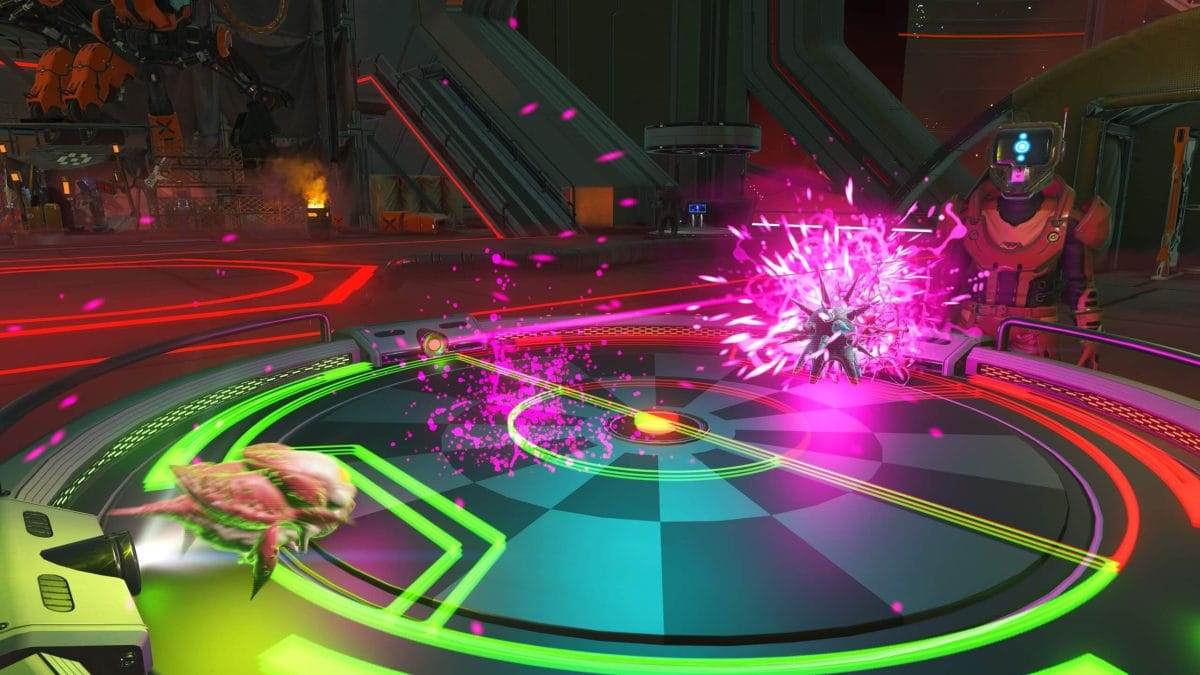
Image: NMS Xeno Update
The 8 Elemental Affinities Explained
Every creature has an affinity tied to its home planet’s biome. This is the backbone of team building. If you’ve played any Pokémon game, you understand the concept: certain types beat certain other types.
The 8 affinities are: Fire, Frost, Radioactive, Toxic, Tropical, Mechanical, Anomalous, and Desert.
The matchup wheel works like this:
- Fire → strong against Frost, weak to Radioactive
- Frost → strong against Desert, weak to Fire
- Radioactive → strong against Fire, weak to Toxic
- Toxic → strong against Radioactive, weak to Tropical
- Tropical → strong against Toxic, weak to Mechanical
- Mechanical → strong against Tropical, weak to Anomalous
- Anomalous → strong against Mechanical, weak to Desert
- Desert → strong against Anomalous, weak to Frost
The key insight that took me a few days to internalize: affinity matchups matter more than raw stats. A B-class creature with the right elemental advantage will consistently beat an S-class creature on the wrong side of the matchup. Build your team around coverage first, stats second.
For Oceanus daily challenges, you won’t know his team composition until you start the fight. This is why you want at least one creature of each major affinity in your roster. The max companion count was increased from 18 to 30 with this update, so there’s room to build a deep bench
Creature Class Ratings: S, A, B, and C
Just like starships and multi-tools, arena creatures have class tiers: C, B, A, and S. Class determines the stat ceiling, not the floor. Three stats matter:
Health – How much damage a creature can absorb before being knocked out.
Agility – The most important stat in the current meta. The creature with the highest Agility acts first each turn. Going first means you apply buffs, debuffs, or knockouts before the opponent can respond.
Combat – Raw damage output.
S-class creatures have the highest potential across all three stats. But here’s the critical thing community testing has confirmed: you cannot “train” a weak creature into a strong one. Base class defines the long-term power ceiling. Retroviral Pellets and experience can improve stats, but they can’t turn a C-class into an S-class. This means the hunt for S-class creatures IS the endgame.
S-Class Creature Hunting: How to Find Them
The Analysis Visor now has a Creature Survey mode (added with 6.3) that shows species information and battle traits for any creature you scan before capturing it. This is essential. Don’t tame randomly; scout first.
Here’s my hunting workflow after two weeks of experimentation:
Step 1: Land on a planet with the biome matching the affinity you need. Want a Toxic creature? Go to a toxic planet.
Step 2: Activate Creature Survey mode on your Analysis Visor and scan everything you see. The visor will show class rating, battle traits, and affinity.
Step 3: Ignore anything below A-class unless you have zero coverage for that affinity. S-class creatures are rare but not impossibly so. I find roughly one every 3-4 planets when actively hunting.
Step 4: When you find an S-class, check its Agility trait specifically. High-Agility S-class creatures are the gold standard in the current meta. Speed determines turn order, and turn order wins fights.
Step 5: Capture it, add it to your roster, and begin the mutation process.
Rarer biomes tend to yield rarer creatures. Hello Games’ official description notes that “legendary variants with unusual and exceptional stats” exist and can be “incredibly valuable.” I haven’t found one yet that I’d call truly legendary, but I’ve seen screenshots from the community of some genuinely absurd stat rolls.
Early Meta Tier List
Important caveat: This is an early meta list based on two weeks of play and community testing. Specific species are procedurally generated and vary between saves, so I’m ranking by archetype and affinity rather than specific named species (which wouldn’t be useful to most players anyway).
S-Tier – Currently Dominant
High-Agility Anomalous creatures. Anomalous affinity is only weak to Desert (which is relatively uncommon in PvP team comps right now) and strong against Mechanical. More importantly, Anomalous creatures tend to have access to unusual status effects and buff-removal abilities. In the current speed-focused meta, an S-class Anomalous creature with high Agility that can strip opponent buffs on turn one is devastating. They’re also harder to find because Anomalous biomes are rarer, which means fewer people have optimized teams to counter them.
S-Class Radioactive tanklines. Radioactive creatures with high Health serve as excellent anchor points for teams. They’re strong against Fire (one of the most common affinities players encounter early on) and their status effects tend toward damage-over-time, which bypasses shields. If you can find an S-class Radioactive creature with both good Health and decent Agility, it’ll carry you through most PvE content.
A-Tier – Consistently Strong
Frost creatures with stun abilities. Stuns are the most impactful status effect in the current meta because they skip the opponent’s turn entirely. Frost creatures access stun abilities more frequently than other types in my testing, and they counter Desert cleanly.
Toxic creatures with DoT stacking. Damage-over-time effects from Toxic creatures compound across turns. Against slower, tankier opponents, this whittles them down while you play defensively. Strong against Radioactive, which is a common NPC team affinity.
Mechanical creatures as sweepers. High Combat, strong against Tropical (which shows up frequently in NPC teams because lush planets are common). Their weakness to Anomalous is manageable if you can identify the matchup early and swap.
B-Tier – Situationally Useful
Fire creatures. Strong against Frost but weak to Radioactive, which is everywhere in the current meta. Fire creatures have good raw damage but the matchup spread works against them right now. Might move up as the meta shifts.
Tropical creatures. Decent abilities and strong against Toxic, but their Mechanical weakness is exploitable. Better in PvE than PvP currently.
Desert creatures. Counter Anomalous (which is S-tier), so they have a specific niche role. The problem is finding S-class Desert creatures: arid planets tend to have lower creature diversity, making the hunt frustrating.
C-Tier-Needs Buffs or Better Team Support
No affinity is truly useless (every type counters something), but creatures with low Agility regardless of class are consistently underperforming. The speed meta is real. If your creature doesn’t act first, the opponent applies their buff, debuff, or stun before you can respond. Slow creatures need a team built around protecting them, which is a harder strategy to execute than just running fast creatures.
Mutation Priorities With Retroviral Pellets
Retroviral Pellets are earned from winning battles and are used to upgrade your creatures’ genetic traits. Here’s the priority order I’ve settled on:
1. Agility first. Always. Turn order is everything right now. Maxing Agility on your best creatures before touching anything else is the single highest-impact upgrade you can make.
2. Health second. Survivability lets your creature stick around long enough to apply status effects and outlast opponents. This matters more than raw damage in most matchups.
3. Combat third. Damage matters, but it matters less than going first and staying alive. Most fights are won by status effects and matchup advantage, not by who hits hardest in a single turn.
You can also modify creature genetics through the Egg Sequencer aboard the Space Anomaly. Breeding two creatures together can produce offspring with combined traits, and personality traits influence battle behavior (aggressive creatures may get bonus attacks more often, cautious ones may dodge more).
Size matters too. Larger creatures tend to be tankier but slower and easier to target. Smaller creatures dodge more often and act faster. This naturally creates team roles: big creatures as frontline absorbers, small ones as damage dealers in the back.
Oceanus Daily Challenge: Team Comp Advice
Oceanus runs the same team for every player each day, which means the community can share strategies. Here’s my general approach:
Bring a mixed-affinity team of three. Don’t go mono-type. Oceanus’s team rotates affinities, and you won’t know what he’s running until the fight starts. A team with three different affinities gives you the best chance of having at least one favorable matchup on the field at all times.
Lead with your fastest creature. The opening turn sets the tone. If your lead can apply a stun or debuff before Oceanus’s creature acts, you’ve swung momentum immediately.
Don’t be afraid to swap mid-fight. You can swap your active creature during your turn to exploit elemental advantages. I spent the first few days never swapping because it felt like “wasting a turn.” It’s not. Getting the right matchup on the field is worth the action cost.
Track cooldowns. Each creature has five abilities, but the stronger ones have cooldowns. Don’t blow your best ability on turn one against a creature you can already beat with basic attacks. Save it for the harder matchup coming next.
Winning Oceanus’s daily challenge rewards nanites, retroviral pellets, and progress toward Arena League medals. If NMS is your first survival game, the nanite economy can feel overwhelming at first – don’t worry, it clicks fast. The Arena League has five tiers with guidance missions, titles, and exclusive creature rewards (Corrupted Quadruped, Geno-Prawn, Wandering Shrimp Tank, Boundary Horror, and Aeron Crab).
Nanite and XP Farming
The fastest nanite farm right now is running Space Station champions repeatedly. System champions at Space Stations are tougher than planetary NPC opponents but give significantly better rewards. Once you have a solid team that can beat a station champion consistently, you can fast-travel between systems and challenge a new champion at each stop.
Creatures earn XP from every battle, win or lose. But winning gives significantly more. The most efficient XP farming method is finding a planetary NPC opponent you can beat in 3-4 turns and running them repeatedly. It’s not glamorous, but it levels your team fast.
Patch 6.33 (April 15) fixed several bugs including NPC opponents using moves that knocked out their own final creature, and stunned creatures still taking bonus turns. If fights felt inconsistent during launch week, try again. It’s noticeably cleaner now. If you’re curious how Xeno Arena fits into the bigger picture of NMS updates, we covered the full state of the game in our 2025-2026 review.
Frequently Asked Questions
How do I unlock Xeno Arena in No Man’s Sky?
You need at least one tamed creature companion (unlocked through the Awakenings questline). Once you have one, interact with any Holo-Arena table found at Space Stations, the Space Anomaly, settlements, or trade outposts. The game provides a tutorial fight to teach the basics.
What are the best creatures for Holo-Arena battles?
In the early meta, high-Agility S-class creatures with status effect abilities (stuns, buff removal, damage over time) outperform raw damage builds. Anomalous and Radioactive affinities are currently strongest due to favorable matchup spreads and access to strong abilities.
How does the affinity system work in Xeno Arena?
Eight affinities (Fire, Frost, Radioactive, Toxic, Tropical, Mechanical, Anomalous, Desert) form a matchup wheel where each type is strong against one and weak against another. Affinity advantage matters more than class rating: a B-class creature with type advantage consistently beats an S-class on the wrong side.
Can I upgrade a C-class creature to S-class?
No. Class rating (C, B, A, S) sets the maximum stat ceiling. Retroviral Pellets and experience improve stats within that ceiling, but you cannot change the base class. Hunt for S-class creatures using the Creature Survey mode on your Analysis Visor.
What should I upgrade first with Retroviral Pellets?
Agility first. Turn order determines who applies buffs, debuffs, and stuns first, which currently decides most fights. Health second for survivability. Combat (raw damage) third.
This is an early meta guide based on two weeks of play since Update 6.3 launched April 8, 2026. The tier list and recommendations will be updated as the community meta develops. Last updated: April 22, 2026.