

If you’ve been gaming for a while, you’ve probably noticed it too — the excitement’s fading a bit.
Big releases drop, trailers look amazing, the hype rolls in… and then, halfway through, you realize you’ve basically played this game before.

Photo by Yan Krukau:
You’re not imagining it.
Lately, every new release feels like a remix of the one before — maybe a new coat of paint, a fancier menu, but it plays the same.
Sure, the trailers look great, the soundtracks hit hard, but once you sit down with it… that spark that used to pull you in for hours just isn’t there anymore.
You finish a mission and think, “Yeah, that was fine,” instead of “holy crap, I need to see what’s next.”
Playing It Safe Comes at a Price
There was a time when a new game could completely blindside you — something weird, something fresh, something that didn’t feel like anything else out there.
That feeling’s still around, just harder to find. You have to go digging through the noise to get to it now.
Budgets have ballooned to movie-studio levels. A single flop can sink a developer, so publishers cling to what’s safe: sequels, reboots, familiar loops that won’t scare investors.
It’s business-smart — but creatively? It’s a straitjacket.
When every decision runs through a spreadsheet, surprise goes missing. Discovery gets trimmed.
And suddenly, an industry that’s never been bigger somehow feels smaller in imagination.
When Familiar Starts Getting Old
Just think about Call of Duty or FIFA — two names you already know by heart.
Every fall, they roll out a shiny new version with the same sales pitch: better graphics, tweaked physics, maybe one headline feature for the trailer.
And sure, they deliver what fans expect — but not much beyond that.
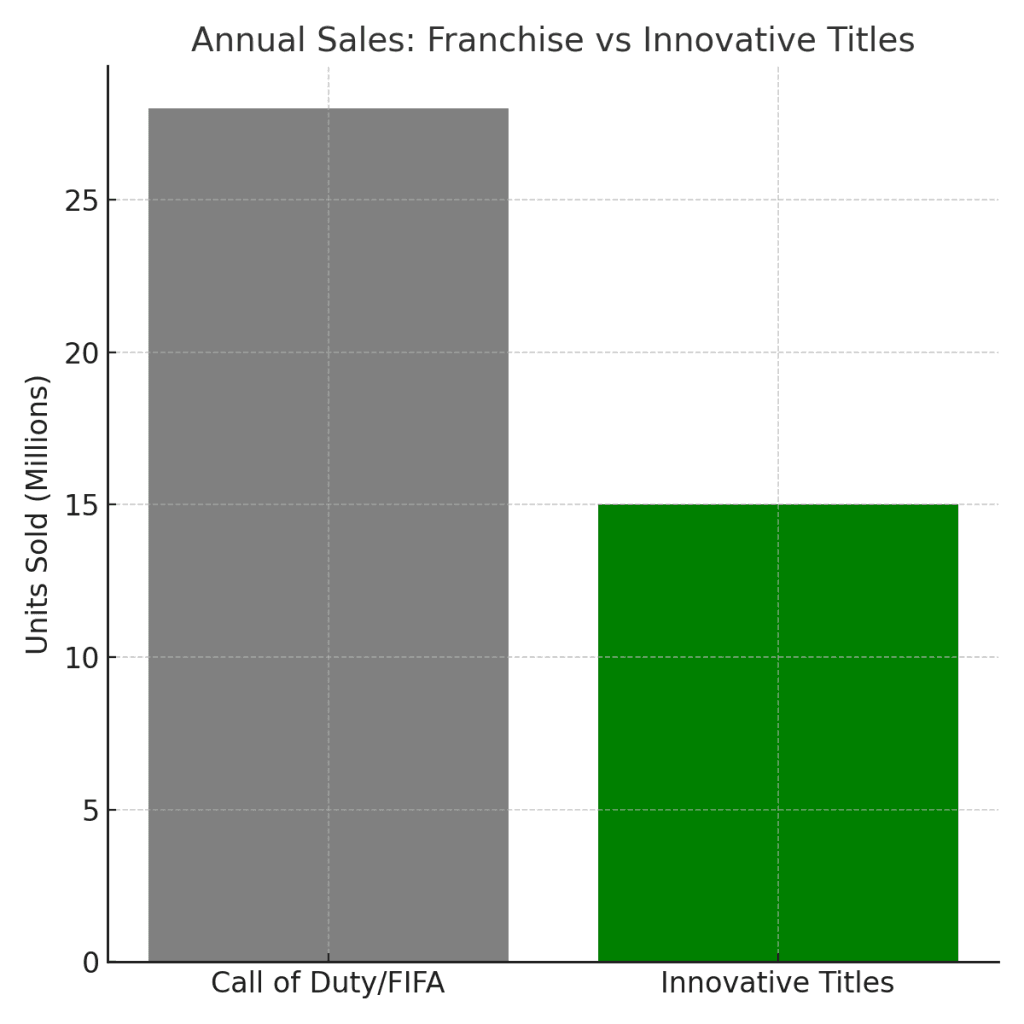
It’s gaming comfort food: familiar, predictable, easy to consume.
But when you’re craving something exciting, paying full price for a patch-level update feels like déjà vu with a receipt attached.
That’s why the few games that do take risks hit so hard. They remind us that surprise is still possible — if someone’s brave enough to try.
Fresh Titles That Break the Mold
Despite all the sameness, a few recent releases prove creativity isn’t dead — it’s just waiting for developers who still care more about players than metrics.
Monster Hunter Wilds
Hack-and-slash games usually burn out fast. You fight, you loot, you repeat — until you’ve had enough.
Monster Hunter Wilds changes that. It doesn’t just toss you into another open map — it throws you into a living system.
The creatures don’t just spawn for your benefit — they live there. They hunt, flee, and fight whether you’re part of it or not.
Each encounter feels like stumbling into someone else’s world, not just checking off a mission log.
Highlights:
- A massive open world with dynamic weather that matters
- Wildlife that acts like actual animals, not set dressing
- Smooth co-op whether you’re on PlayStation, Xbox, or PC
- Worlds that react to you — storms roll in, habitats change, stuff moves on its own
Black Myth: Wukong
If you like games that actually make you pay attention — fights that punish you for blinking, worlds that look hand-carved — this one’s it.
It pulls everything together: the combat, the folklore, the atmosphere. Nothing feels tacked on. It’s all one heartbeat, one idea.
Highlights:
- Stunning visuals built on Unreal Engine 5
- A narrative drawn from Journey to the West
- Staff-based combat that’s fast, fluid, and punishing
- Huge launch buzz backed by real substance
Lost Ark
If you’ve been craving a huge adventure that actually feels alive, Lost Ark nails it.
It’s somewhere between an action RPG and an MMO, stuffed with exploration and spectacle.
What keeps it interesting is how it constantly switches things up — one minute you’re fighting through dungeons, the next you’re sailing off to some island you’ve never heard of.
Highlights
- Dozens of classes and playstyles that actually feel different
- A mix of solo quests and massive co-op raids
- Regular updates that add regions and storylines
- Combat that’s flashy, quick, and hits hard — but only if your timing’s on point
Hollow Knight: Silksong
Indies aren’t underdogs anymore — a lot of them are setting the standard.
Silksong is a perfect example. It’s slow-cooked, detailed, and proof that taking your time can still pay off.
It’s not something you breeze through — it demands focus, rewards curiosity, and fills every corner with quiet mystery.
Highlights:
- Launching across all major platforms
- Hornet takes center stage as the needle-wielding protagonist
- A haunting interconnected world that rewards exploration
- Optional “wish” quests and a detailed journal system
- Tight platforming and combat that keep you on edge
The Future Looks Bright
Sure, things feel slow right now. But it’s not the death of creativity — more like a calm before the storm.
You can already see the shift. Smaller studios are taking the lead, pulling ideas from passion instead of profit sheets.
And when those projects start landing, even the big publishers will have to take notes. Players aren’t going to keep paying for reruns forever.
The good news?
You can already feel the spark coming back.
When it hits, it won’t just mean prettier graphics or bigger worlds — it’ll bring back that sense of awe and challenge that made us fall in love with games in the first place.
This dry spell won’t last forever. You can already sense the next era building — and honestly, it might be the most exciting one yet.