
Roguelike deckbuilders are having the best year the genre has ever seen. Slay the Spire 2 sold 5 million copies in its first month. Monster Train 2 hit a 95% positive rating on Steam. Balatro spawned an entire sub-genre of “Balatro-likes.” And we’re only in April.
I’ve played most of these. Some for hundreds of hours, some for dozens, and a couple I’m still in the early stages of. This isn’t a list of every roguelike deckbuilder that exists. It’s a ranked list of the ones actually worth your time in 2026, with honest takes on what each one does best and where it falls short. If you’ve got limited hours and need to know where to start, this is the guide.
1. Slay the Spire 2
Platforms: PC (Steam) | Price: $24.99 (Early Access) | Status: Early Access since March 5, 2026
The king is back, and it earned the crown immediately. Slay the Spire 2 sold 3 million copies in its first week and crossed 5.3 million by the end of March, generating over $108 million on Steam alone. Those numbers are absurd for an Early Access indie game. For context, the original Slay the Spire took its entire lifetime to hit around 3.6 million copies on Steam.
Five playable characters ship in Early Access: three returning favorites (Ironclad, Silent, Defect) and two brand new classes. The Necrobinder comes with Osty, a giant skeleton hand companion that attacks and shields independently. The Regent forges a sovereign blade and uses a unique “stars” resource system. Both new classes feel genuinely different from anything in the original.
The biggest addition is co-op for up to four players with multiplayer-specific cards and team synergies. I’ve played co-op and it transforms the experience into something closer to a tabletop night than a solo grind. Alternate acts randomize which version of each act you encounter per run, and the new Enchantments system lets you upgrade cards with trade-off modifiers.
The honest caveat: it’s Early Access on Steam, and it shows in spots. Recent Steam reviews are Mixed (69% positive) because players are responding to balance patches, placeholder art on newer content, and the growing pains of an evolving game. The overall rating is 95% Overwhelmingly Positive from 113,000+ reviews. If you’re the kind of person who doesn’t mind playing an unfinished masterpiece as it takes shape, this is the best deckbuilder on the market. If you want a polished final product, wait a year.
Best for: Players who want the deepest, most replayable deckbuilder available — and don’t mind Early Access rough edges.
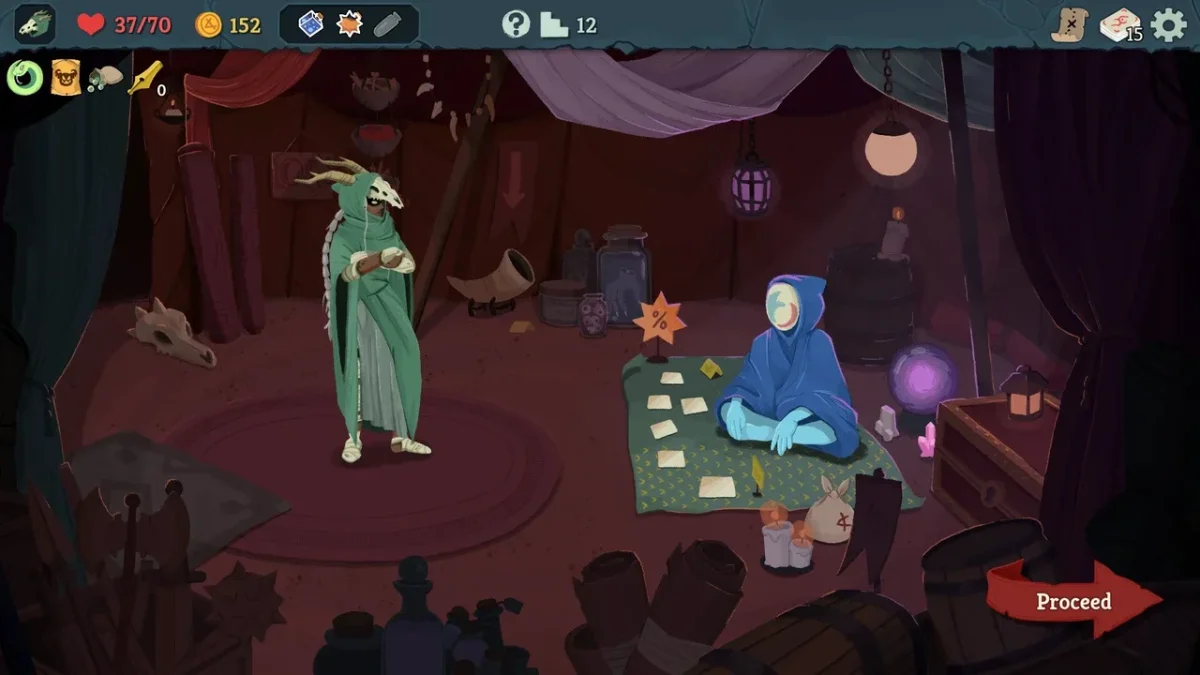
Image: Press Kit
2. Balatro
Platforms: PC, PS4, PS5, Xbox, Switch, Mobile | Price: $14.99 | Steam rating: Overwhelmingly Positive (97%)
Balatro doesn’t need a long introduction at this point. It took poker, stripped it down, added Joker modifiers that break the scoring system in absurd ways, and became one of the most acclaimed indie games of the decade. Multiple Game of the Year nominations. Millions of copies sold. An entire sub-genre named after it.
What makes Balatro special is its simplicity. You already know poker hands. The game teaches you the rest in minutes. But 200 hours later you’re still discovering synergy combinations you’ve never tried. That accessibility-to-depth ratio is unmatched in the genre. My partner, who doesn’t play games, got hooked on Balatro within one session. That almost never happens.
If you haven’t played it, start here. Seriously. It’s $15 and it’ll consume your life.
Best for: Everyone. The universal entry point for the genre.
3. Monster Train 2
Platforms: PC, PS5, Xbox, Switch | Price: $24.99 | Steam rating: Overwhelmingly Positive (95%)
Monster Train 2 is what happens when a studio takes everything that worked about the original, adds meaningful new layers, and doesn’t break what wasn’t broken. The three-tiered vertical battlefield is still the defining mechanic: enemies climb your train floor by floor, and you deploy units on each level to stop them before they reach your Pyre. The spatial strategy this creates is what separates Monster Train from every other deckbuilder.
The sequel adds Heaven and the Abyss as new realms, angelic factions alongside the demonic originals, Room and Equipment cards for more tactical options, and Pyre Hearts that let you customize each run before departing. The Railforged DLC (released early 2026) introduced a whole new clan with Forge, Smelt, and Refine mechanics. Metacritic sits at 89, and the 95% Steam rating across nearly 5,000 reviews speaks for itself.
The one criticism that echoes across reviews: if you played the original extensively, some of Monster Train 2 can feel familiar to the point of fatigue. It’s an evolution, not a revolution. But if you’re new to the series, or you loved the first and want substantially more of it, this is essential.
Best for: Players who want tactical depth beyond card-playing, with positioning and resource management baked into every decision.
4. Inscryption
Platforms: PC, PS4, PS5 | Price: $19.99 | Steam rating: Overwhelmingly Positive (96%)
I’m including Inscryption even though it’s from 2021, because it’s still the most memorable deckbuilder I’ve ever played and new people are discovering it constantly. If you haven’t played it, stop reading this article and go in completely blind. Seriously. Don’t read reviews. Don’t watch trailers. Just buy it.
What I can say without spoiling anything: it starts as a cabin-in-the-woods card game with horror elements, and then it becomes something else entirely. Multiple times. The less you know, the more powerful the experience. The card game mechanics are excellent on their own, but they’re in service of a larger narrative that I genuinely can’t discuss without ruining it.
The reason it still ranks this high is that nothing else has replicated what Inscryption does. Other games are better pure deckbuilders. No other game combines deckbuilding with narrative surprise like this.
Best for: Players who want a deckbuilder that’s also an unforgettable story. Go in blind.
5. Beyond Words
Platforms: PC, PS5, Xbox, Switch | Price: ~$12 | Status: Released April 9, 2026 | Steam rating: Positive (91%)
The wildcard on this list, and the one most people haven’t heard of yet. Beyond Words is Balatro meets Scrabble, made by the creators of GoldenEye 007 and TimeSplitters. Yes, that sounds like three unrelated things smashed together by an algorithm. No, it actually works.
You place letter tiles on a board to form words and score points, just like Scrabble. But between rounds, you purchase power cards (essentially Balatro’s Jokers) that multiply your scores in increasingly ridiculous ways. Chain the right modifiers with high-value words and you’ll go from struggling to hit 500 points to casually posting 250,000. Over 300 unique modifiers and abilities keep the runs fresh.
The main criticism across reviews is that the difficulty spikes can feel brutally luck-dependent in later rounds. If you don’t draw the right power cards, some bosses become nearly impossible regardless of your vocabulary skills. That randomness frustration is a real issue, but the core loop is so compelling that I keep launching “one more run” anyway.
It’s a week old and only has 49 Steam reviews, so this is genuinely a sleeper pick. If you’re a word person who loved Balatro, this is your next obsession.
Best for: Scrabble fans, word game enthusiasts, and anyone looking for the next Balatro-style addiction.
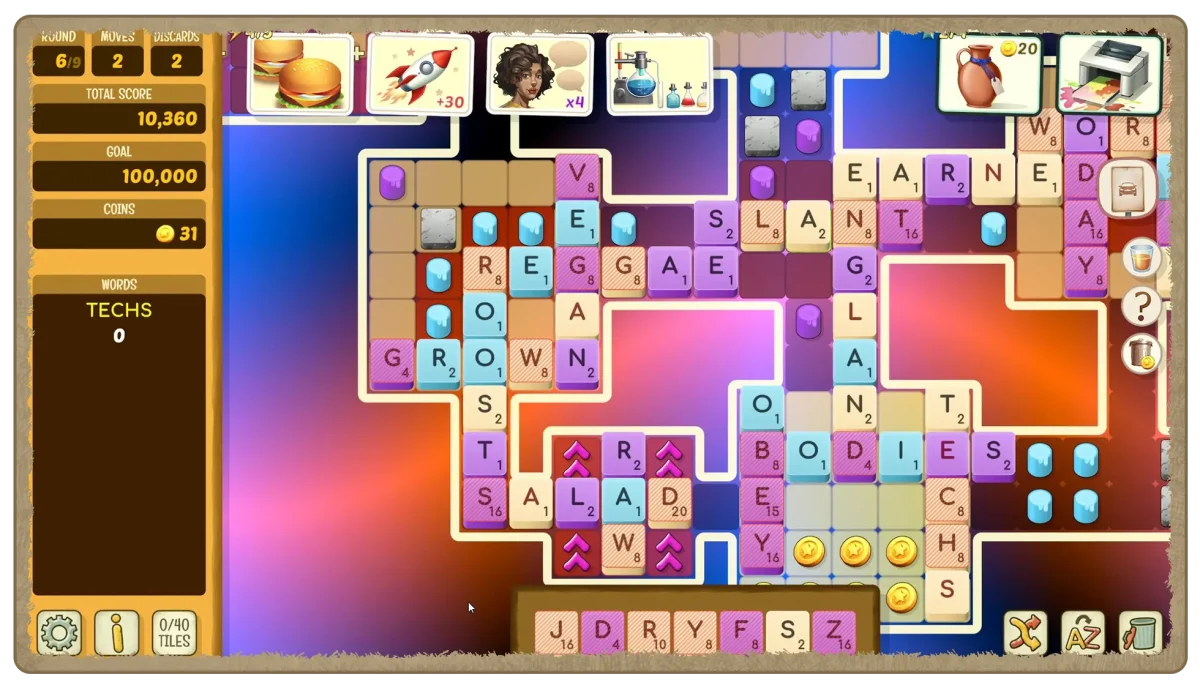
Image: pqube.co.uk – beyond-words
6. Vampire Crawlers: The Turbo Wildcard from Vampire Survivors (Most Anticipated — Launches April 21)
Platforms: PC, PS5, Xbox, Switch | Price: TBC | Status: Launches April 21, 2026 | Day One on Game Pass
I haven’t played the full game yet because it’s not out for five more days, so I’m ranking this based on the Steam Next Fest demo, preview coverage, and the pedigree of the Vampire Survivors franchise. PC Gamer’s Wes Fenlon sat down for a “brief spin” of the demo and lost two hours. That tracks with how Vampire Survivors operates: accessibility so frictionless that you don’t notice time passing.
Vampire Crawlers is a turn-based dungeon-crawling deckbuilder set in the Vampire Survivors universe. You play cards in ascending mana order to build combos, with each card multiplying the next one’s effect. The “Turboturn” system is the hook: you can play slowly and tactically, or blitz through turns as fast as humanly possible.
Available on Game Pass day one, the barrier to entry is basically nonexistent. Poncle (the Vampire Survivors studio) co-developed this with Nosebleed Interactive (Arcade Paradise), and they’ve confirmed post-launch support. If it delivers on the demo’s promise, this could be the casual deckbuilder that introduces millions of Vampire Survivors fans to the genre.
Best for: Vampire Survivors fans curious about deckbuilders, and anyone who wants a lighter, faster alternative to Slay the Spire.
7. Slay the Spire (The Original)
Platforms: PC, PS4, Xbox, Switch, Mobile | Price: $24.99 | Steam rating: Overwhelmingly Positive (97%)
The game that defined the modern roguelike deckbuilder, and it still holds up perfectly. Over 10 million copies sold across all platforms. 97% positive on Steam. If you’ve never played a deckbuilder before and the idea of jumping into a sequel’s Early Access feels wrong, start here. Four characters, an ascension system that adds 20 levels of escalating difficulty, and the tightest balance in the genre.
The reason it ranks below its sequel is simply that Slay the Spire 2 does everything the original does and adds co-op, new classes, alternate acts, and Enchantments. But the original is complete, polished, and available on every platform including mobile. There’s no Early Access ambiguity. It’s a finished masterpiece.
Best for: Newcomers to the genre, mobile players, and anyone who wants a complete, polished experience right now.
8. Griftlands
Platforms: PC, Switch | Price: $19.99 | Steam rating: Very Positive (89%)
Griftlands is the deckbuilder I recommend to people who want more narrative with their card game. Developed by Klei Entertainment (the Don’t Starve studio), it features three separate campaigns with distinct characters, each with two decks: a combat deck for fighting and a negotiation deck for talking your way out of problems. The negotiation system is genuinely unique in the genre, turning conversations into strategic card battles where you can convince, intimidate, or manipulate NPCs.
It doesn’t get the same hype as the games above because it launched in a crowded window and its difficulty is lower than the hardcore deckbuilder audience expects. But the writing is sharp, the art is excellent, and the dual-deck system is an idea I’m surprised more games haven’t stolen.
Best for: Players who want story and character alongside deckbuilding, and who enjoy the idea of “combat but with words.”
Honorable Mentions
Roguebook – Solid deckbuilder with a hex-based exploration map and two-character party system. Doesn’t quite reach the heights of the top picks but worth a look on sale.
Gordian Quest – Deeper RPG elements with party-based deckbuilding across a longer campaign. More niche, but scratches a different itch.
Cobalt Core – Sci-fi deckbuilder with spaceship combat where you physically dodge enemy attacks by shifting your ship’s position. Unique mechanic, charming writing.
What to Play First
If you’ve never touched the genre: Balatro. It’s $15, it’s on every platform, and it’ll teach you whether you love this type of game within 30 minutes.
If you’re already a fan and want the biggest experience in 2026: Slay the Spire 2, with the caveat that it’s Early Access.
If you want something polished and finished right now: Monster Train 2 or the original Slay the Spire.
If you want something nobody else is playing yet: Beyond Words.
Frequently Asked Questions
What is the best roguelike deckbuilder for beginners?
Balatro. It uses poker hands everyone already understands, teaches its systems quickly, and has a forgiving learning curve with massive depth underneath. It’s also $14.99, making it the cheapest entry point on this list.
Is Slay the Spire 2 worth buying in Early Access?
Yes, with caveats. It’s already one of the most content-rich deckbuilders available, with five characters, co-op, and hundreds of hours of replayability. But it’s being actively balanced, has placeholder art in spots, and recent reviews are Mixed due to patch volatility. If that bothers you, the original Slay the Spire is a finished masterpiece at the same price.
How many copies has Slay the Spire 2 sold?
Over 5.3 million copies on Steam in its first month of Early Access (March 2026), generating approximately $108 million in revenue. It was the top-selling game on Steam for March 2026.
Is Vampire Crawlers a real deckbuilder or just Vampire Survivors with cards?
Based on the demo, it’s a genuine turn-based deckbuilder with roguelite elements. It has dungeon crawling, card combos, deck customization, and strategic decision-making. The Vampire Survivors DNA shows in its accessibility and pacing, but the gameplay is structurally different. It launches April 21, 2026, and is on Game Pass day one.
What’s the best roguelike deckbuilder on Game Pass?
Monster Train 2 is available on Game Pass and is one of the best deckbuilders ever made (95% positive on Steam, Metacritic 89). Vampire Crawlers joins Game Pass on April 21. Both are excellent options for subscribers.